
Storage Unit Size Guide
Storage units are priced by size, so renting one too big wastes money every month and one too small means a second trip. This guide estimates the volume of your belongings from a checklist of common items and boxes, allows for the space you can’t fill perfectly, and suggests the smallest standard unit that should fit.
- Free to use
- No sign-up
- Runs in your browser
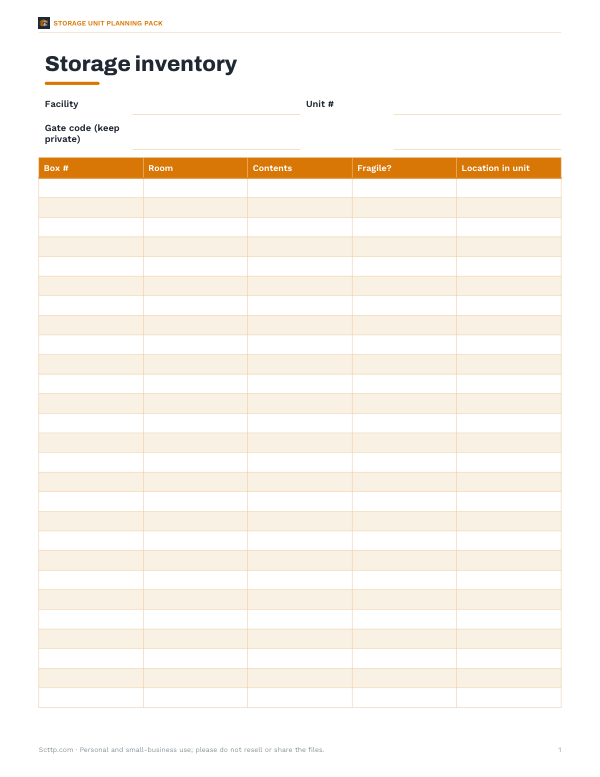
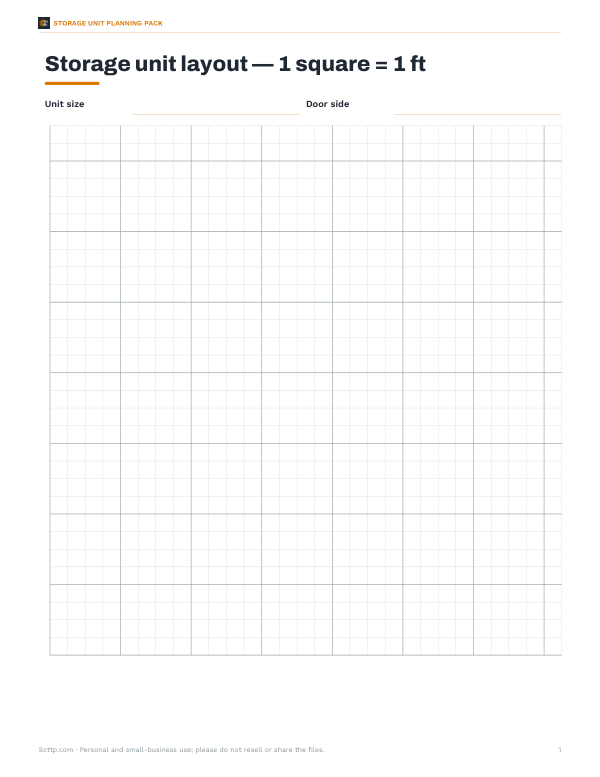
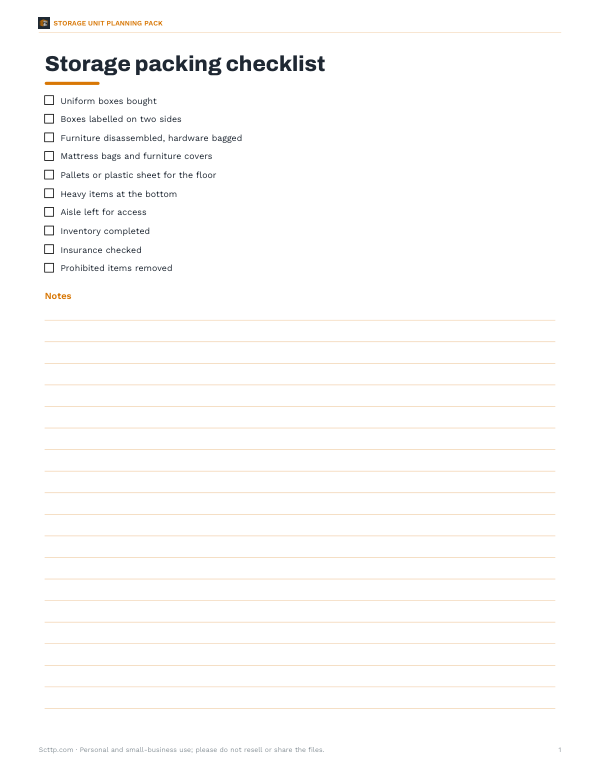
Storage unit size estimator
Storage Unit Planning Pack
Printable storage planning sheets: inventory by box, unit layout grid, packing checklist and a facility comparison sheet.
- Box inventory (PDF/DOCX/XLSX)
- Layout grid (PDF)
- Packing checklist (PDF/DOCX)
- Facility comparison (PDF/DOCX/XLSX)
Formats: PDF, DOCX, XLSX. Instant download after payment (link valid 72 hours, up to 5 downloads). AI-assisted: the templates were drafted with AI help and reviewed and laid out before publishing.
$5.00 USD, one-time 4 files · about $1.25 each
- Instant download
- 7-day refund
- Secure checkout by Stripe
7-day money-back guarantee. Full refund within 7 days of purchase, even after you download.
Free sample: Facility Comparison (PDF, 52 KB)
Full refund within 7 days — see the refund policy and license.
Free printables
Single sheets you can print right now, no sign-up. The full pack adds every sheet in one download plus the editable files.
 Printable Storage Facility Comparison Chart
Standard storage unit sizes
| Size (ft) | Floor area | Comparable to | Typically holds |
|---|---|---|---|
| 5 × 5 | 25 sq ft | Small closet | Boxes, seasonal items, a small chair, bike |
| 5 × 10 | 50 sq ft | Walk-in closet | Contents of a studio: mattress, dresser, boxes |
| 5 × 15 | 75 sq ft | Large walk-in closet | Small one-bedroom without large appliances |
| 10 × 10 | 100 sq ft | Half a one-car garage | One-bedroom apartment |
| 10 × 15 | 150 sq ft | Small bedroom | Two-bedroom apartment |
| 10 × 20 | 200 sq ft | One-car garage | Two- to three-bedroom home, or a car |
| 10 × 25 | 250 sq ft | Long one-car garage | Three-bedroom home |
| 10 × 30 | 300 sq ft | Large garage | Four- to five-bedroom home |
Most units have ceilings around 8 feet, so a 10 × 10 unit holds roughly 800 cubic feet of space — but you can rarely fill it all. The “typically holds” column is a rough guide; the estimator above is more precise because it uses your actual belongings.
Why packing efficiency matters
Furniture doesn’t stack like bricks. Legs, odd shapes and the need to leave an aisle mean most people use 60–80% of a unit’s volume. The estimator divides your item volume by the efficiency you choose: a relaxed 60% leaves space to reach things, while 80% assumes careful stacking of boxes to the ceiling. If you will need to get into the unit often, choose relaxed.
Worked example: a one-bedroom apartment
A sofa (45 cu ft), armchair (15), dining table (30) with four chairs (20), a dresser (20), a bookcase (15), a boxed TV (10), 15 medium boxes (22.5), 10 large boxes (30), two wardrobe boxes (20) and a bicycle (10) add up to about 238 cubic feet. At 70% efficiency that needs about 340 cubic feet of space — within a 5 × 10 unit’s 400 cubic feet, but tight. Adding a queen bed (60) pushes the need to about 425 cubic feet, so a 5 × 15 or 10 × 10 unit becomes the better choice.
Climate-controlled or standard?
| Choose climate control for | Standard is usually fine for |
|---|---|
| Wood furniture and pianos | Garden tools and outdoor furniture |
| Electronics and appliances | Plastic storage bins |
| Documents, photos and books | Metal shelving |
| Artwork, instruments, leather | Vehicles (check the facility rules) |
| Mattresses and upholstered furniture | Short-term storage in mild climates |
Climate-controlled units keep temperature and humidity within a range, reducing warping, mould and corrosion. They cost more, so many people store only sensitive items there.
Packing a storage unit
- Use uniform boxes so they stack evenly; put heavy boxes at the bottom.
- Stand sofas on end only if the manufacturer allows it; otherwise use them as a base for light boxes.
- Disassemble bed frames and tables and keep the hardware in labelled bags.
- Leave an aisle down the middle, and put items you’ll need first at the front.
- Raise items off the floor on pallets in case of moisture.
- Label boxes on at least two sides and keep an inventory.
Moving house vs long-term storage
For a gap of a few weeks between homes, a unit near your new address with drive-up access makes unloading easy, and a slightly larger size saves the effort of perfect packing. For long-term storage — a year abroad, downsizing, a renovation — it pays to pack carefully to the ceiling, choose climate control for sensitive items and keep a detailed inventory, because you may not remember what is in each box months later. Visiting every few months to check for damp or pests is sensible for long rentals.
Business storage
Small businesses use storage units for stock, archives, equipment and seasonal displays. Shelving along the walls makes better use of height than stacking boxes, and a clear aisle with labelled shelves turns a unit into a small warehouse. Check whether the facility allows deliveries to be accepted on your behalf, has trolleys and loading bays, and whether business use is permitted under the standard contract.
Measuring large items
- Measure sofas, wardrobes and appliances before you go — length, width and height.
- Check the unit’s door height and width, not just the floor size.
- Remember that tall items need the ceiling height; a unit may be 8 ft inside but the door lower.
- Upright pianos and large mirrors need padding and should stand against a wall.
What you usually can’t store
Most facilities prohibit flammable liquids (petrol, paint thinners), hazardous chemicals, perishable food, living things, firearms and explosives, and unregistered vehicles. Rules vary, so read the rental agreement. Check whether your home insurance covers stored belongings or whether the facility requires its own cover.
Choosing a facility
- Compare the monthly rate and any introductory discounts — and what the rate rises to afterwards.
- Check access hours, gate security and cameras.
- Ask about drive-up access if you have heavy furniture.
- Measure the door opening for large items.
- Read the notice period for moving out.
Privacy
The estimator runs in your browser; nothing about your belongings is uploaded.
Frequently asked questions
What size storage unit do I need for a one-bedroom apartment?
Usually a 10 × 10, or 5 × 15 if you pack tightly.
How much fits in a 10 × 10 storage unit?
About 800 cubic feet of space with an 8 ft ceiling — typically a one-bedroom apartment.
Can a car fit in a storage unit?
A 10 × 20 unit usually fits a standard car; check the facility rules.
What is a 5 × 5 storage unit good for?
Boxes, seasonal items and a few small pieces of furniture.
Do I need climate control?
For wood furniture, electronics, documents and anything sensitive to heat or humidity, it’s worth considering.
Is my information saved?
No. It stays in your browser.